Last Updated on March 13, 2026 by admin
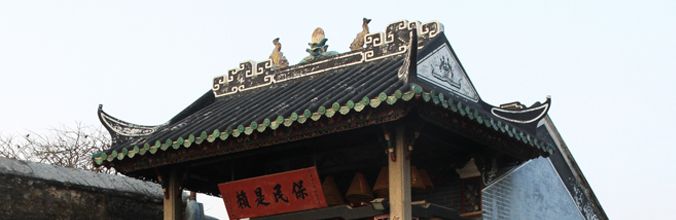
Tucked just a few steps from one of Macau’s most photographed landmarks, the Na Tcha Temple (Templo Na Tcha, 大三巴哪吒廟) is one of those places that visitors almost always walk past without realising it. Squeezed between the iconic Ruins of St. Paul’s and a stretch of traditional street, this compact Chinese folk temple is easy to miss — but it rewards those who stop and take it in. It tells a story about Macau’s history that the grander buildings around it simply can’t.
Who Is Na Tcha?
Na Tcha (哪吒) is one of the most beloved and colourful figures in Chinese mythology — a young, mischievous warrior deity with a fiery spirit to match. Often depicted as a child riding fire wheels, wielding a cosmic ring and wearing red silk armlets, he’s a protector figure known for his bravery, speed, and willingness to take on anyone, regardless of size or power. He appears in the classic Chinese novel Investiture of the Gods and later in Journey to the West, and has been a cultural fixture in southern Chinese and Taoist tradition for centuries.
In Macau, Na Tcha was believed to have protective powers against disease and misfortune — which brings us to why this particular temple exists at all.
A Temple Born Out of Plague
The Na Tcha Temple was built in 1888 during a devastating plague outbreak that had swept through the region. In traditional Chinese belief, constructing a temple to a powerful deity in times of crisis was a way to seek divine intervention and protection for the community. Na Tcha, with his reputation as a fearless guardian, was considered well-suited to the task.
The temple was built beside the ruins of the old St. Paul’s Cathedral — a striking choice that speaks to Macau’s layered cultural identity. At the time, the ruins were already one of the most distinctive landmarks in the city, and positioning this small Chinese temple in their shadow created one of the most unusual — and telling — juxtapositions you’ll find anywhere in Macau.
A UNESCO World Heritage Site
In 2005, the Na Tcha Temple was officially inscribed as part of the Historic Centre of Macau, the UNESCO World Heritage Site that encompasses 22 buildings and spaces across the peninsula. It was selected not despite its small size but partly because of what it represents: a living example of the peaceful coexistence of Chinese and Portuguese cultures in Macau over centuries.
That coexistence is nowhere more obvious than right here — a traditional Chinese folk temple standing directly beside the remains of a 17th-century Jesuit cathedral. It’s the kind of scene that sums up Macau’s character better than any guidebook introduction.
What to See
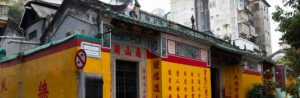
The temple itself is small — a single-room structure with a traditional curved roof, red lanterns, and the warm haze of incense smoke that seems to permanently hang in the air. Inside, the main altar holds a gilded image of Na Tcha, surrounded by offerings of fruit, flowers, and ceremonial items left by devotees.
Don’t rush through it. Take a moment to let your eyes adjust and look at the details: the hand-painted tiles, the carved wooden panels, the small figurines tucked into corners. It’s an active temple, and you’ll often find locals pausing to pray, light incense, or simply pay their respects — a reminder that this isn’t just a heritage attraction, but a place of genuine faith.
Step outside and turn around: the contrast of the Ruins of St. Paul’s looming above while incense drifts from the temple below is a genuinely memorable sight.
Practical Information
Opening hours: Generally 8:00am – 5:00pm daily, though as an active temple, hours can vary.
Admission: Free.
Getting there: The temple is located on Rua de São Paulo, immediately behind and to the right of the Ruins of St. Paul’s. It’s a short walk uphill from Senado Square — follow the souvenir-lined steps toward the ruins and keep an eye to your right as you approach.
Tip: Visit early in the morning if you can. The souvenir stalls haven’t fully set up, the crowds are thin, and you’ll find the area around the ruins and the temple far more peaceful — and far more photogenic.
3 thoughts on “Na Tcha Temple”